Currency Pairs Explained: How to Read, Compare, and Choose Forex Pairs
Every forex trade involves two currencies. You buy one, you sell the other. That combination is called a currency pair, and having currency pairs explained clearly is the single most foundational step in forex trading.
A currency pair quotes one currency against another, with the base currency listed first and the quote currency second. Pairs fall into three groups: major, minor, and exotic. Major pairs always include the US dollar, carry the tightest spreads, and dominate global volume.
This article breaks down how to read currency pairs, what separates major, minor, and exotic currency pairs, where the "28 pairs" concept comes from, and which pairs suit beginners best. It draws on real volume data from the Bank for International Settlements (BIS) and gives you practical guidance on choosing the right pairs for your trading style.
What Is a Currency Pair and How Does It Work?
A currency pair is two currencies quoted together. Understanding how currency pairs work is essential: the price tells you how much of one currency you need to buy a unit of the other.
The first currency listed is the base currency. The second is the quote currency, sometimes called the counter currency. The quoted price tells you how many units of the quote currency it costs to buy one unit of the base.
Take EUR/USD quoted at 1.0850. That means one euro costs 1.0850 US dollars. If you believe the euro will strengthen against the dollar, you buy the pair. If you think it will weaken, you sell.
Price changes are measured in pips, the smallest standard price increment in a currency pair, typically the fourth decimal place (0.0001). If EUR/USD moves from 1.0850 to 1.0851, that is one pip.
For JPY-quoted pairs such as USD/JPY, a pip is the second decimal place (0.01), so a move from 149.50 to 149.51 is one pip.
This market is enormous. The BIS reported $7.5 trillion in average daily OTC foreign exchange turnover in April 2022, up 14% from $6.6 trillion in April 2019. The latest BIS triennial survey shows that figure rose to $9.6 trillion per day in April 2025, up 28% from 2022. That scale means currency pairs trade around the clock, five days a week, with liquidity no other financial market matches.
How to Read Currency Pairs: Bid, Ask, and Spread
Learning how to read currency pairs comes down to two prices: the bid and the ask.
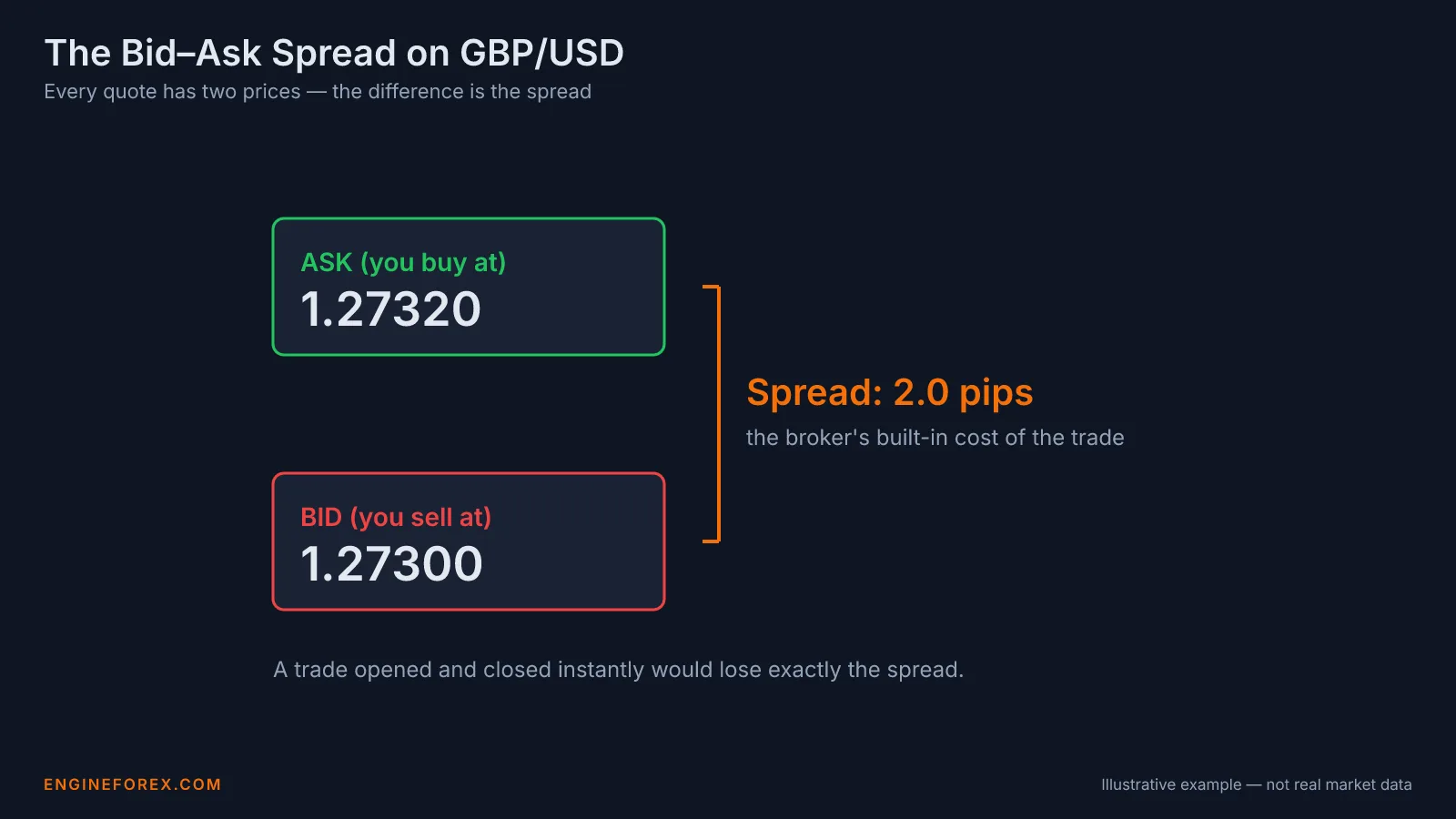
The bid price is what buyers are willing to pay for the base currency. The ask price is what sellers are demanding. The gap between them is the spread, a cost you pay on every trade.
Suppose GBP/USD shows a bid of 1.27300 and an ask of 1.27320. The spread is 2.0 pips. If you go long (buy), you purchase British pounds and sell US dollars at the ask price of 1.27320. You profit if GBP/USD rises.
If you go short (sell), you sell pounds and buy dollars at the bid price of 1.27300. You profit if GBP/USD falls.
| Quote Component | What It Means | GBP/USD Example |
|---|---|---|
| Base currency | The currency you are buying or selling (listed first) | GBP |
| Quote currency | The currency used to express the price (listed second) | USD |
| Bid price | Price at which buyers will purchase the base | 1.27300 |
| Ask price | Price at which sellers will sell the base | 1.27320 |
| Spread | Ask minus bid; your transaction cost | 2.0 pips |
| Pip | Smallest standard price increment (0.0001 for most pairs) | 0.00010 |
Always check whether your broker quotes four or five decimal places. Five-decimal pricing gives you fractional pip visibility, which matters for short-term strategies where entry precision counts.
The base currency is always on the left. The quote currency is always on the right. Every forex pair follows this format. Once you understand how to read currency pairs in this way, every quote you encounter will make immediate sense.
Major, Minor, and Exotic Currency Pairs: What Is the Difference?
Forex pairs fall into three categories based on which currencies they combine and how much trading volume they attract. Understanding major, minor, and exotic currency pairs is central to having currency pairs explained in a useful way, because these categories directly affect your costs, your risk, and how smoothly your orders get filled.
What Are the Major Forex Pairs?
Major pairs always include the US dollar on one side, paired with another currency from a large, developed economy. The standard major currency pairs list: EUR/USD, USD/JPY, GBP/USD, USD/CHF, AUD/USD, USD/CAD, and NZD/USD.
These seven absorb the bulk of global forex volume, though the exact share is debated. One estimate puts majors at approximately 72% of global forex trading volume.
A second source claims 85%, though this higher figure may conflate the share of trades that simply involve the US dollar (89.2% per BIS 2025) with the share attributable strictly to major pairs. Both figures come from broker educational content, and that discrepancy is worth noting. Regardless, majors clearly dominate.
The practical advantage: major pairs carry the tightest spreads and deepest liquidity, with predictable intraday volume profiles. For traders focused on keeping execution costs low, this is where the math works best.
What Are Minor Currency Pairs (Crosses)?
Minor pairs, also called crosses, combine two major currencies without the US dollar. EUR/GBP, EUR/JPY, GBP/JPY, and AUD/CAD are common examples.
Volume estimates vary. One source puts minors at approximately 18 to 20% of forex volume, while another suggests 10 to 15%. Spreads on crosses run wider than majors but remain manageable for most strategies.
Price movements in crosses tend to be driven by regional interest rate differentials and trade flows between the two economies involved.
What Are Exotic Currency Pairs?
Exotics combine a major currency with a currency from an emerging or smaller economy. Think USD/TRY (Turkish lira), USD/ZAR (South African rand), USD/MXN (Mexican peso), and USD/SGD (Singapore dollar).
No verified percentage for exotic pairs' share of global volume was found in available sources. What is clear: exotics carry wider spreads, elevated average daily ranges, and heightened sensitivity to country-specific risk.
Liquidity is thinner, and volatility runs higher.
| Type | Definition | Examples | Typical Spread | Liquidity |
|---|---|---|---|---|
| Major | USD + another major economy | EUR/USD, USD/JPY, GBP/USD | Lowest | Deepest |
| Minor (Cross) | Two major currencies, no USD | EUR/GBP, EUR/JPY, GBP/JPY | Moderate | Good |
| Exotic | Major + emerging/small economy | USD/TRY, USD/ZAR, USD/MXN | Highest | Thinnest |
The pattern is straightforward. The further you move from majors, the more you pay in spread and the more volatility you face. This is a core principle whenever currency pairs explained guides discuss risk management.
The Most Traded Currency Pairs in 2026
EUR/USD remains the world's most traded currency pair. According to BIS April 2025 triennial survey data, EUR/USD holds a 21.2% share of global forex volume, followed by USD/JPY at 14.3% and GBP/USD at 7.6%.

For context, BIS 2022 data showed EUR/USD at 23%, USD/JPY at 14%, and GBP/USD at 9%. EUR/USD's share has edged down slightly. USD/JPY has held steady.
| Pair | BIS 2022 Volume Share | BIS 2025 Volume Share |
|---|---|---|
| EUR/USD | 23% | 21.2% |
| USD/JPY | 14% | 14.3% |
| GBP/USD | 9% | 7.6% |
One pattern holds across every survey: all ten of the most traded pairs involve the US dollar. The dollar's role as the world's primary reserve currency makes this unsurprising, but it reinforces why the major currency pairs list should be your starting point.
Between 2022 and 2025, some pairs saw notable growth. USD/CNY turnover rose 59%, USD/CHF rose 60%, and USD/HKD surged 95%, reflecting shifting trade flows and monetary policy divergences.
These shifts are worth watching because they signal where institutional capital is moving.
What Are the 28 Forex Pairs?
You will see "28 forex pairs" referenced constantly in trading education. Here is where the number comes from: take eight major currencies (USD, EUR, GBP, JPY, CHF, AUD, CAD, NZD) and pair each one with every other.
The combination formula (8 choose 2) produces exactly 28 unique pairs. This is the origin of every 28 major forex pairs list you will encounter.
| Group | Count | Pairs |
|---|---|---|
| USD pairs (majors) | 7 | EUR/USD, GBP/USD, USD/JPY, USD/CHF, AUD/USD, USD/CAD, NZD/USD |
| EUR crosses | 6 | EUR/GBP, EUR/JPY, EUR/CHF, EUR/AUD, EUR/CAD, EUR/NZD |
| GBP crosses | 5 | GBP/JPY, GBP/CHF, GBP/AUD, GBP/CAD, GBP/NZD |
| JPY crosses | 4 | CHF/JPY, AUD/JPY, CAD/JPY, NZD/JPY |
| CHF crosses | 3 | AUD/CHF, CAD/CHF, NZD/CHF |
| AUD crosses | 2 | AUD/CAD, AUD/NZD |
| CAD cross | 1 | NZD/CAD |
A clarification worth making: the phrase "28 major forex pairs" is technically a misnomer. Within those 28, only 7 are true majors (each involving USD). The remaining 21 are crosses or minors.
No single authoritative institutional body, including the BIS, publishes an official "28 major forex pairs list." The concept is a trader convention, not a regulatory designation. Treat it as a useful framework, not gospel.
Best Currency Pairs for Beginners
Start with major pairs. The reasoning is practical, not theoretical. Choosing the best currency pair to trade for beginners comes down to cost, liquidity, and information availability.
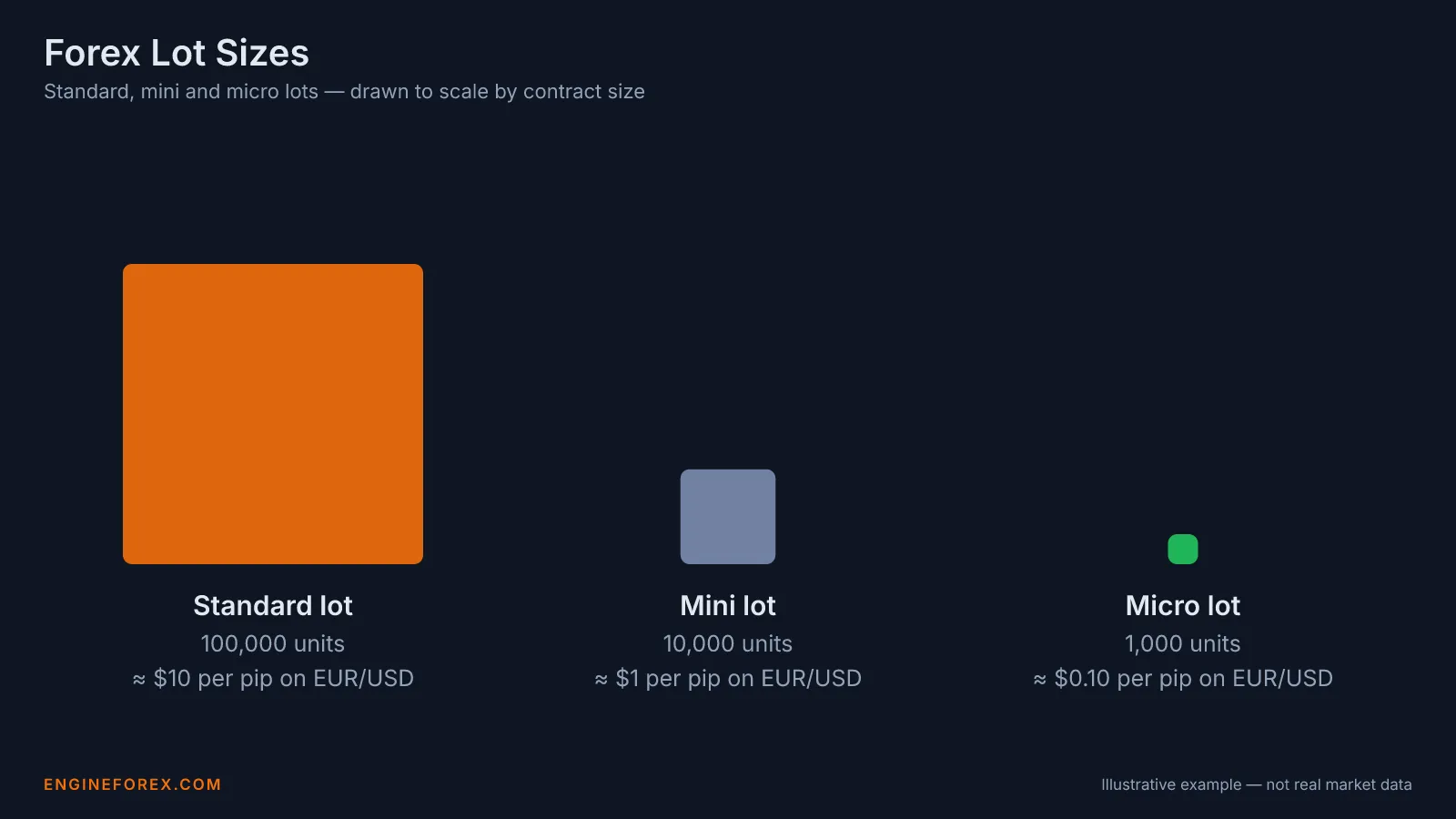
Major pairs offer tighter spreads, which means lower transaction costs on every trade. They have deeper liquidity and more predictable intraday volume profiles.
That translates to fewer sudden price gaps and less slippage (the difference between the price you expected and the price you actually got).
EUR/USD is the natural starting point. It carries the highest volume globally at 21.2% of forex turnover, produces the tightest spreads across virtually every broker, and attracts the most news coverage and analysis.
When something moves EUR/USD, you will find explanations quickly. That transparency matters when you are learning to connect price action with fundamentals.
USD/JPY and GBP/USD are also commonly recommended as best currency pairs for beginners, for the same liquidity reasons.

Here is a practical currency pairs list for beginners to start building a watchlist from:
| Pair | Why It Suits Beginners |
|---|---|
| EUR/USD | Highest volume, tightest spreads, most analysis available |
| USD/JPY | Deep liquidity, active during Asian and New York sessions |
| GBP/USD | Strong liquidity, active during London and New York sessions |
| AUD/USD | Liquid, tied to commodity flows, active during Asian hours |
| USD/CAD | Liquid, correlated with oil prices, predictable drivers |
A word of caution on exotics: wider spreads eat into small accounts, higher volatility can trigger stop-losses quickly, and thinner liquidity introduces slippage risk. None of that is ideal when you are still learning order execution and risk management.
How Do Swap Rates Affect Overnight Holds?
Be aware of swap rates (overnight rollover charges). When you hold a position past the daily rollover time, you either pay or earn a swap based on the interest rate differential between the two currencies.
Swap costs can be substantial on exotic pairs and high-rate-differential crosses, so factor them in before deciding to hold a trade overnight.
Why Does Pair Correlation Matter for Your Watchlist?
Watch out for correlation between pairs. Pairs that share a common currency tend to move together. For example, going long both EUR/USD and GBP/USD effectively doubles your USD-short exposure. When building a watchlist from the 28 pairs, check correlations so you do not unknowingly concentrate your risk.
How Should You Match Pairs to Trading Sessions?
Liquidity and spreads for a given pair vary by session. EUR pairs are most liquid during the London and New York overlap, while JPY and AUD pairs tend to see their tightest spreads during Asian hours.
Matching your trading schedule to the sessions where your chosen pair is most active helps you get better fills and lower costs.
From a risk management perspective, learning to size positions properly on a liquid major pair is far more valuable than chasing wide swings on an exotic where your spread alone may consume a significant portion of your target move.
Currency Pairs That Move 100 Pips a Day
This section addresses the common search for currency pairs that move 100 pips a day.
Exotic pairs tend to produce the largest daily price swings. Pairs like USD/TRY, USD/ZAR, and USD/MXN carry elevated average daily ranges and heightened sensitivity to country-specific risk.
Major pairs generally produce tighter daily ranges because deep liquidity absorbs large orders without as much price disruption.
However, specific verified pip-per-day figures for individual pairs were not found in the available research. Any article citing precise daily pip ranges without a methodology or data source deserves your skepticism.
Here is what you can count on: large daily moves come with proportionally larger costs. Wider spreads, thinner liquidity, and higher slippage potential mean that a 100-pip move on an exotic pair does not translate into 100 pips of profit nearly as cleanly as it might appear on a chart.
The net capture after spread and slippage is the number that actually matters to your account balance. When you see currency pairs that move 100 pips a day, always compare the average daily range against the typical spread to judge the real opportunity.
Frequently Asked Questions
Was this article helpful?