Best Time to Trade Forex: Sessions Explained and Optimal Trading Hours

You have probably heard that the forex market never sleeps. That is mostly true. It runs 24 hours a day, five days a week, cycling through four major trading sessions: Sydney, Tokyo, London, and New York. But "always open" does not mean "always worth trading."
The best time to trade forex, according to multiple industry sources, is during the London-to-New York overlap, roughly 13:00 to 17:00 GMT (8 a.m. to 12 p.m. EST). That is when liquidity (how easily you can buy or sell without moving the price against yourself) peaks, spreads (the gap between the buy and sell price, which is your cost on every trade) compress to their tightest, and price moves enough to work with.
Below, every session is broken down with exact hours, the days that matter, and when you are better off stepping away.
What Are the 4 Forex Trading Sessions?
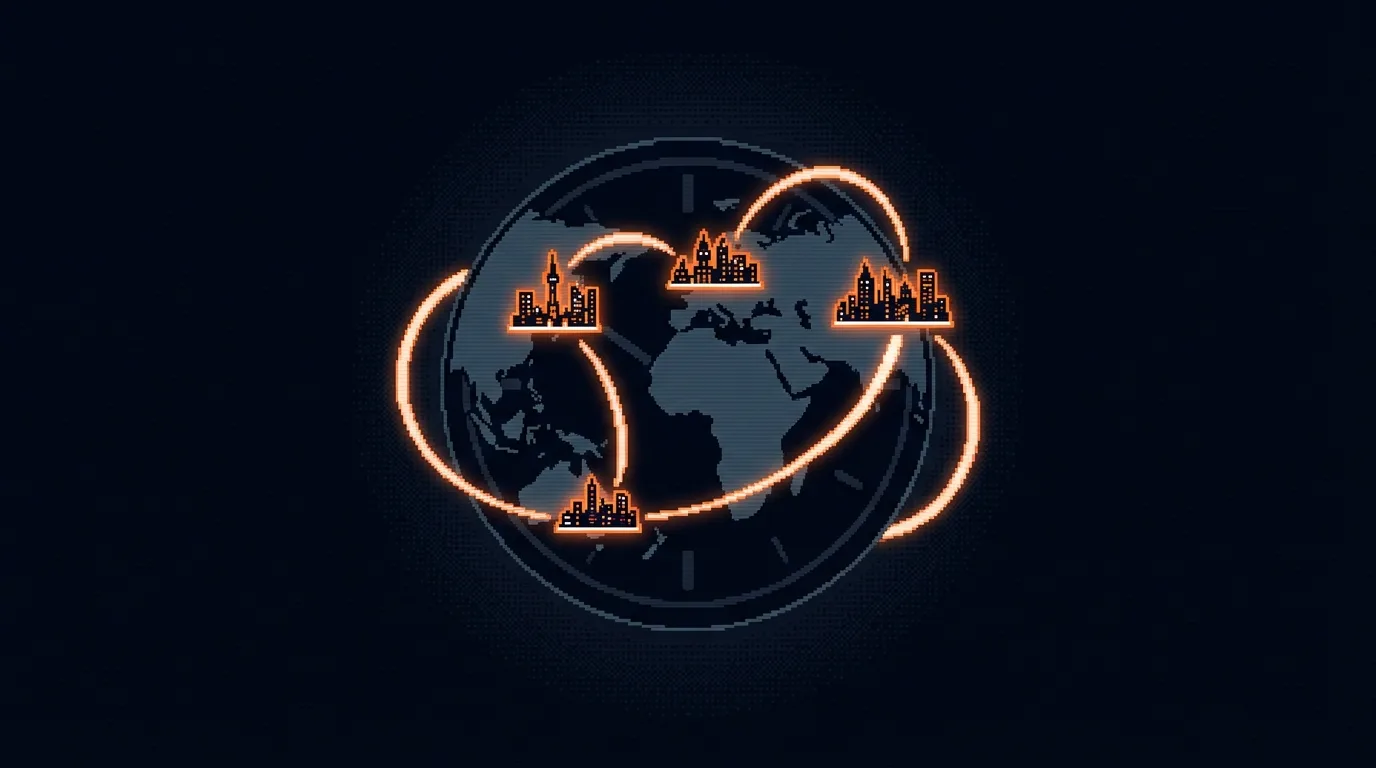
Think of forex sessions like shifts at a global office. When one financial center closes for the day, the next one picks up. This rolling handoff keeps the market running continuously during the trading week. Each session has its own personality.
Sydney Session
The Sydney session opens at 21:00 GMT and closes at 06:00 GMT. It kicks off the trading week and is the quietest of the four. The major financial centers in Europe and North America are dark.
If you trade currencies tied to the Australian or New Zealand dollar (AUD or NZD), this session matters most to you. For everyone else, it is a transition period. Liquidity is thin and spreads are wider. This is rarely the session where you want to force entries on major pairs.
What Happens During the Tokyo (Asian) Session?
The Tokyo session runs from 23:00 to 08:00 GMT, or approximately 7 p.m. to 4 a.m. EST. It overlaps briefly with the tail end of Sydney, which adds a small bump in activity early on.
Compared to London or New York, this session is calmer. Price tends to grind rather than surge. There is also a brief Tokyo-London overlap (roughly 07:00 to 08:00 GMT) that can produce a pickup in activity on cross pairs like EUR/JPY and GBP/JPY.
If you focus on JPY pairs (like USD/JPY, which accounts for 14.3% of daily forex volume), this is your window. Some traders prefer the slower pace because it gives more time to react, and the reduced noise can make price action easier to interpret for those still building their read on the market.
Why Is the London (European) Session So Important?
London is the heavyweight. It runs from approximately 08:00 to 17:00 UK time, or 07:00 to 16:00 GMT.
In EST, that translates to roughly 3 a.m. to 12 p.m.
Why does London dominate? Sheer volume. London and New York together process more than half of all global forex volume.
The 8 a.m. London open is a particularly high-activity moment, often setting the directional tone for the rest of the day. EUR/USD, the most traded pair at 21.2% of daily volume, sees its tightest spreads here. GBP/USD (7.6% of daily volume) follows the same pattern.
If you trade European currencies, this session is not optional. It is your primary market.
New York (North American) Session
The New York session runs from 8 a.m. to 5 p.m. EST, or approximately 13:00 to 22:00 GMT. Some sources list the GMT range as 12:00 to 21:00, a difference caused by daylight saving conventions.
This session is defined by high volatility (large, fast price swings) and heavy order flow. Its first few hours overlap with London, and that overlap is where the market reaches peak activity. After London closes, New York continues but the pace softens noticeably.
What Time Does the Forex Market Open and Close in 2026?
The forex market opens at 5 p.m. EST on Sunday and closes at 5 p.m. EST on Friday. During the trading week, it never shuts down. One session simply hands off to the next.
| Session | Open (GMT) | Close (GMT) | Open (EST) | Close (EST) |
|---|---|---|---|---|
| Sydney | 21:00 | 06:00 | 5 p.m. | 1 a.m. |
| Tokyo | 23:00 | 08:00 | 7 p.m. | 4 a.m. |
| London | 07:00 | 16:00 | 3 a.m. | 12 p.m. |
| New York | 13:00 | 22:00 | 8 a.m. | 5 p.m. |
These times can shift by one hour when daylight saving changes take effect. The table above uses winter (standard) GMT offsets. During summer time, all EST and UK session times shift one hour earlier relative to GMT. The figures reflect the most commonly cited ranges across available sources.
Also note that many brokers use a server time of GMT+2 or GMT+3, which affects how daily candles print on your charts and when the swap/rollover charge is applied. If exact timing matters to your strategy, confirm against your broker's posted schedule and server time setting.
When Is the Best Time to Trade Forex?
The London-to-New York overlap. This window is the single most consistently recommended trading period across industry sources, and the reasoning holds up.

What Are Forex Session Overlaps and Why Do They Matter?
A session overlap occurs when two major trading sessions are open at the same time. The three key overlaps are:
- Sydney-Tokyo overlap (roughly 00:00 to 06:00 GMT): a modest liquidity bump for AUD, NZD, and JPY pairs.
- Tokyo-London overlap (roughly 07:00 to 09:00 GMT): a brief window that can spark activity on cross pairs like EUR/JPY and GBP/JPY.
- London-New York overlap (roughly 13:00 to 17:00 GMT): the highest-liquidity, tightest-spread window of the entire 24-hour cycle.

Of the three, the London-New York overlap is by far the most significant for retail traders.
What Makes the London-to-New York Overlap Special?
During this overlap, both London and New York are active simultaneously. The result is the highest combined liquidity of the entire 24-hour cycle. More participants mean tighter spreads, which directly lowers your cost on every trade.
This overlap runs from approximately 13:00 to 17:00 GMT, or 8 a.m. to 12 p.m. EST. Some sources place it at 12:00 to 16:00 GMT, a slight variation tied to daylight saving conventions.
Volatility (how much and how quickly a price moves) also peaks during this window. Without price movement, there is nothing to capture. The combination of tighter spreads and stronger directional moves creates the most favorable ratio of opportunity to cost, something that particularly benefits scalpers and short-term traders who rely on thin margins per trade.
Which Days of the Week Are Best for Trading?
Tuesday, Wednesday, and Thursday are typically the strongest. Monday tends to be slower as the market digests weekend news and finds direction. Friday sees reduced participation as traders close positions ahead of the two-day shutdown.
Which Forex Session Is Most Profitable?
This is where honesty matters. No verified data on per-session profitability or win rates was found in available sources. Anyone telling you one session "guarantees" profits is selling something, not informing you.
What the evidence does support is that certain sessions create better conditions. The table below summarizes how each session compares on the factors that most directly affect your trading costs and opportunity.
| Session | Relative Liquidity | Typical Spread Width | Volatility Level | Best-Suited Pairs |
|---|---|---|---|---|
| Sydney | Lowest | Widest | Lowest | AUD/USD, NZD/USD |
| Tokyo | Low-Moderate | Moderate-Wide | Low-Moderate | USD/JPY (14.3% of daily volume), EUR/JPY, GBP/JPY |
| London | Highest (single session) | Tightest | High | EUR/USD (21.2%), GBP/USD (7.6%) |
| New York | High | Tight | Highest | EUR/USD, USD/CAD, USD/JPY |
| London-New York Overlap | Peak | Tightest of the cycle | Peak | EUR/USD, GBP/USD, USD/JPY |
In summary:
- London offers the tightest spreads, lowering your cost per trade.
- New York delivers the highest volatility, creating more room for price to move.
- The overlap combines both advantages.
- Tokyo may suit you if you trade JPY pairs. Its calmer pace produces less noise and more readable price action.
"Most profitable" ultimately depends on your strategy, your currency pairs, and how you manage risk. Better conditions reduce friction. They do not replace skill.
What Is the Worst Time to Trade Forex?
Certain periods consistently produce worse conditions. Recognizing them can save you real money.

The Sunday open. The market reopens at 5 p.m. EST on Sunday, and this is when gap risk runs highest. A gap is a jump in price between Friday's close and Sunday's open, with no trades in between.
Weekend events can cause prices to open far from where they closed, triggering stop-loss orders or producing unexpected losses.
Late overnight hours. The window between roughly 10 p.m. and 8 a.m. is generally not recommended for trading major pairs. Liquidity dries up and spreads widen. Wider spreads mean you start every trade further from breakeven.
After 17:00 GMT. Volatility tends to decrease after this point as London closes and New York winds down. Price movement becomes less directional and harder to read.
Around major scheduled news releases. Even during peak-liquidity hours, high-impact events such as Non-Farm Payrolls, CPI prints, and central bank rate decisions can cause spreads to blow out and slippage to spike for a few minutes around the release. Check an economic calendar before placing trades.
In plain terms: the worst time to trade forex is when fewer participants are in the market. Fewer participants mean wider spreads, thinner order books, and choppier price action.
| Time Period | Why It Is Risky | Primary Concern |
|---|---|---|
| Sunday open (5 p.m. EST Sunday) | Weekend gaps, thin liquidity | Gap risk, wide spreads |
| Late overnight (10 p.m. to 8 a.m. local) | Major centers closed | Widest spreads, low volume |
| After 17:00 GMT weekdays | London closed, New York winding down | Reduced volatility, less directional movement |
| Around high-impact news releases | Sudden liquidity withdrawal | Spread blowouts, slippage |
What Time Frame Should Beginners Use for Forex Trading?
There is a distinction worth understanding clearly. A "trading session" refers to when a major financial center is open. A "chart time frame" is the duration each candle or bar represents on your price chart (for example, 1-hour candles, 4-hour candles, or daily candles). These are two separate concepts, though they often get conflated.
The best time frame to trade forex for beginners is not something the available research pins to a single answer backed by comparative data. What can be said with confidence: beginners benefit most from trading during high-liquidity periods, specifically the London session or the London-to-New York overlap.
During these windows, spreads are tighter and price behavior tends to be more orderly, which makes learning easier and reduces unnecessary costs.
Choosing a chart time frame is a separate decision. It depends on how long you plan to hold trades and how much screen time you can realistically commit.
How Big Is the Forex Market? Putting Session Volume in Context
The forex market is the largest financial market in the world. Global FX turnover reached approximately $9.6 trillion per day according to the BIS 2025 Triennial Survey. To give you a sense of scale: that single day of trading exceeds the annual GDP of most countries.
FX swaps (an agreement to exchange currencies at one date and reverse the exchange later) make up roughly 42% of that turnover, or $4.0 trillion daily. Spot transactions (trades settled "on the spot," typically within two business days) account for 31% of turnover.
Why does this matter to you? A bigger market means more participants competing on price, which compresses spreads and speeds up execution. You are trading in the deepest liquidity pool available in any financial market.
| Metric | Value |
|---|---|
| Total daily FX turnover (BIS 2025) | ~$9.6 trillion |
| FX swaps share of turnover | 42% (~$4.0 trillion/day) |
| Spot transactions share of turnover | 31% |
| Most traded pair (EUR/USD) share | 21.2% |
| USD/JPY share of daily volume | 14.3% |
| GBP/USD share of daily volume | 7.6% |
Frequently Asked Questions
Was this article helpful?