How Does an Economic Calendar Work and Why Do Forex Traders Use It?
You have a trade open on EUR/USD. Everything looks clean on the chart. Then, without warning, price drops 80 pips in under a minute. You check the news. The US Federal Reserve just announced an interest rate hold that nobody expected.
The information was scheduled, publicly available, and free to access. You just did not check. Understanding how does an economic calendar work is the first step toward never making that mistake again.
That is the problem an economic calendar solves. It is a publicly available schedule of upcoming economic events, data releases, and central bank decisions known to move currency markets.
If you have ever wondered what is economic calendar in trading, the short answer is: it is the single most accessible tool for knowing when volatility is coming. Forex traders use it to plan trades, manage risk during volatile windows, and stop getting blindsided by news they could have seen coming.
This guide walks you through how to read an economic calendar, which events deserve your attention, how to build a routine around using economic calendars for trading, and which tools are worth considering in 2026.
What Is an Economic Calendar in Forex Trading?
An economic calendar is a schedule of upcoming economic events and data releases, like inflation, jobs, GDP, and rate decisions, that can influence financial markets. Think of it as a weather forecast for the markets.
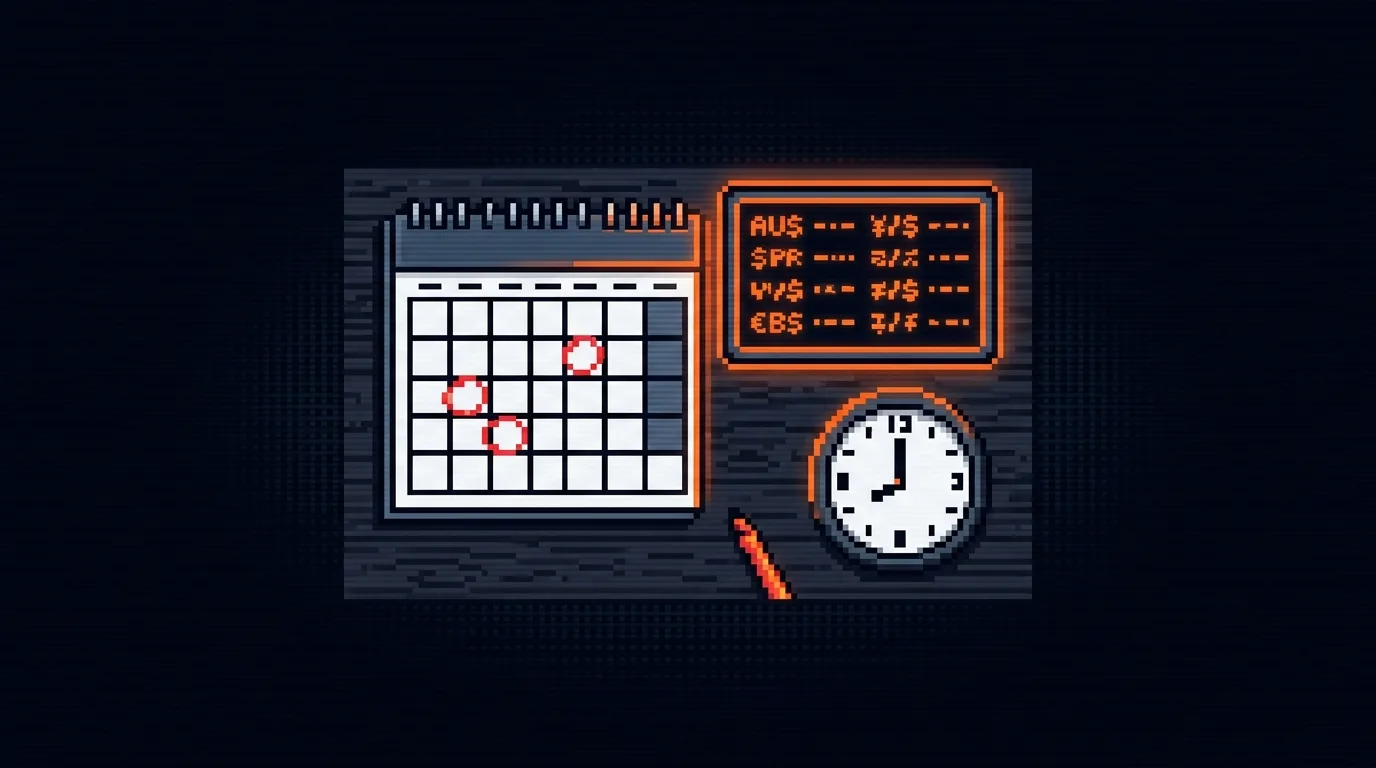
It will not tell you exactly what will happen, but it tells you when conditions are likely to shift. For anyone asking how does an economic calendar work in practice, it organizes every scheduled release into a single, filterable timeline so you can see at a glance what is coming and when.
The calendar tracks releases from economies around the world. These include Gross Domestic Product (GDP, the total value of goods and services a country produces), Consumer Price Index (CPI, a measure of inflation based on prices consumers pay), Non-Farm Payrolls (NFP, a monthly count of jobs added or lost in the US), Purchasing Managers' Index (PMI, a forward-looking survey of business conditions), interest rate decisions by central banks, consumer confidence reports, and central bank speeches.
The table below summarizes the most commonly tracked indicators and why they matter for understanding forex economic calendar data:
| Indicator | What It Measures | Why Forex Traders Watch It |
|---|---|---|
| Interest Rate Decisions | Central bank borrowing cost changes | Directly affects currency demand and carry trade flows |
| Non-Farm Payrolls (NFP) | Monthly US job creation | Key gauge of US economic health; moves all USD pairs |
| Consumer Price Index (CPI) | Inflation at the consumer level | Primary input for central bank rate decisions |
| Gross Domestic Product (GDP) | Total economic output | Broadest measure of an economy's strength or weakness |
| Purchasing Managers' Index (PMI) | Business activity in manufacturing/services | Forward-looking indicator of economic momentum |
| Consumer Confidence | Household spending outlook | Signals future consumer spending trends |
These calendars are free. Trading Economics describes its calendar as updated 24 hours a day. Investing.com provides a real-time, streaming schedule of economic events and data releases.
You do not need a paid subscription. The information is available to anyone with a browser, making the economic calendar for forex traders one of the most accessible tools in the market.
How to Read an Economic Calendar: What Each Column Means
Every economic calendar displays the same core information, organized into columns. Learning how to read economic calendar forex layouts is straightforward once you know what each column represents.
| Column | What It Shows | Why It Matters |
|---|---|---|
| Date & Time | When the release is scheduled | Ensures you are prepared before the event, not after |
| Country / Currency | Which economy the data belongs to | Points to the currency pair most likely to move |
| Impact Rating | Low, medium, or high expected importance | Helps you prioritize which events to watch |
| Forecast | Market consensus expectation | The benchmark against which the actual result is judged |
| Previous | Last reported value | Provides context and can itself be revised |
| Actual | The real number once published | The surprise versus forecast is what drives price action |
How Do Date and Time Work on the Calendar?
Each event shows the date and exact time it will be released. The time displayed must match your local timezone, or you will miss events entirely. Multiple sources describe correct timezone settings as non-negotiable.
Most tools let you adjust the timezone in settings. Some traders set it to GMT for consistency, then convert mentally to their local time.
Be aware that Daylight Saving Time shifts in the US and EU occur on different dates each spring and fall. This can cause release times to shift by one hour relative to your local clock for a few weeks. Double-check your settings during these transition periods.
What Do the Country and Currency Columns Tell You?
A flag or country tag next to each event tells you which economy the data comes from. This matters because it points directly to which currency pair will be affected. UK inflation data, for instance, may influence sterling pairs, while US employment figures may move pairs containing the US dollar.
This is one reason why the economic calendar for forex traders is organized by country rather than by topic.
What Does the Impact Rating Mean?
Events are tagged by expected importance: low, medium, or high. High-impact events are the ones most likely to cause sharp price movement.
Forex Factory uses color-coded folders, with red folders signaling high impact. If you are just getting started, filter for high-impact events only and ignore the rest until you are comfortable reading the calendar's rhythm.
How Do Forecast, Previous, and Actual Values Work?
These three numbers are the heart of the calendar, and knowing how to read an economic calendar means understanding how they interact. The forecast is the market's consensus expectation, the previous is the last reported value, and the actual is the real number published at the scheduled time.
Here is the insight most beginners miss: price responds to the gap between the actual figure and what was expected, not to whether the number is good or bad in absolute terms. Say analysts expected 200,000 new jobs and the actual number comes in at 150,000. Markets may react sharply, even though 150,000 sounds healthy on its own. The surprise is what drives the move.
One more nuance: some major releases, including GDP and NFP, have preliminary, revised, and final readings. The "previous" value can itself be revised at the moment of the new release, creating a double surprise.
Even when the headline number matches the forecast, a significant revision to the prior reading can still trigger sharp moves.
Which Economic Events Move Forex Markets the Most?
Not all releases carry equal weight. When using economic calendars for trading, it helps to know which events consistently generate the most volatility (rapid, significant price swings) in forex:
- Interest rate decisions by central banks such as the Federal Reserve, European Central Bank, and Bank of England. These directly affect borrowing costs and the relative attractiveness of holding a currency.
- Non-Farm Payrolls (NFP), released monthly by the US Bureau of Labor Statistics, measuring job creation in the American economy.
- Consumer Price Index (CPI), the primary inflation gauge and a major input into central bank rate decisions.
- Gross Domestic Product (GDP), the broadest measure of economic output.
- Purchasing Managers' Index (PMI), a survey-based indicator of business activity in manufacturing and services.
- Central bank speeches, where officials hint at future policy changes.
Multiple sources single out rate decisions, CPI, and NFP as the releases to prioritize. If you only have time to watch a handful of events each month, those three are where you start.
Checking the economic calendar today forex schedule for these releases should be the first thing you do before any trading session.
Why Do Forex Traders Use the Economic Calendar?
Understanding why do forex traders use economic calendar tools comes down to four concrete reasons.
How Does It Help With Planning and Timing Trades?
The calendar helps you plan and time decisions. If you know US inflation data drops at 8:30 AM Eastern on Tuesday, you can decide ahead of time whether to enter a trade on USD pairs before or after the release.
Without the calendar, you are trading blind. This is the core of how to use an economic calendar for trading: matching your entries and exits to the schedule of events that move your pairs.
How Does It Help Manage Risk Around Volatility?
Scheduled releases create predictable windows of increased volatility, reduced liquidity (fewer buyers and sellers at each price), and wider spreads (the gap between the buy and sell price your broker quotes). The calendar helps traders identify these periods so they can adjust stop losses (preset exit orders that limit losses), reduce position sizes (the amount of capital committed to a trade), or step aside entirely.
Does It Support Fundamental Analysis?
Yes. Fundamental analysis means evaluating currencies based on economic data rather than chart patterns. The economic calendar is mainly used by followers of fundamental analysis to build a directional view of where a currency should be heading based on the strength or weakness of its underlying economy.
An economic release calendar trading approach layers each new data point onto the broader fundamental picture.
Can It Help You Avoid Nasty Surprises?
This might be its most important function for newer traders. The calendar lets you trade around events intentionally rather than into them blindly.
If you have ever watched a trade move sharply against you for no apparent reason, a scheduled release likely triggered it.
Can the Economic Calendar Predict Forex Prices?
No. And this is worth being blunt about. Many traders search "can the economic calendar predict forex," and the honest answer is that calendars cannot show unscheduled news and do not determine how prices will respond.
The calendar tells you when something will happen and what the market expects. It does not tell you what the actual number will be or how traders will react. Two identical surprises on two different days can produce completely different price moves depending on broader sentiment, positioning, and what else is happening in the world.
Treat it as a preparation tool, not a crystal ball. Understanding how does an economic calendar work means accepting its limits: it manages risk and frames expectations, but it does not generate trade signals on its own.
How to Use an Economic Calendar for Trading: A Step-by-Step Routine
The most practical way to use the calendar is to build a repeatable routine around it. Below is a step-by-step framework for using economic calendars for trading effectively.

What Should You Do at the Start of Each Week?
Open your calendar on Sunday evening before the trading week begins. Set your timezone. Filter for high-impact events only if you swing trade, or high plus medium if you day trade.
For each high-impact event, note the release time, the consensus forecast, and the previous reading. If your calendar shows a historical volatility graph, check the historical 15-minute range for that event.
This tells you how far price has typically moved during that release in the past.
What Should You Check Before Each Trading Session?
Before opening any position, scan the next 24 to 48 hours for high-impact releases. Identify which currency pairs are most exposed.
Then set a firm rule: no new trades five to ten minutes before key events. This protects you from entering right as volatility spikes.
Checking the economic calendar today forex schedule should become as routine as checking your charts.
How Should You Handle Each High-Impact Release?
Mark a 30-minute window around each high-impact event on your chart. During that window, expect wider spreads, faster price action, and possible slippage (your order filling at a different price than expected).
Decide in advance what you will do. Your options: close the trade entirely before the release, reduce your position size, widen your stop loss to avoid getting stopped out by the initial spike, or stay flat during the window. After the number drops, give the market a few minutes to settle before acting.
| Step | Action | Timing |
|---|---|---|
| 1 | Weekly review of high-impact events | Sunday evening |
| 2 | Set timezone and filter by impact level | Once per week (verify during DST transitions) |
| 3 | Note forecast, previous, and release time for key events | Sunday evening |
| 4 | Pre-session scan of next 24-48 hours | Before each trading session |
| 5 | No new trades within 5-10 minutes of a high-impact release | Ongoing rule |
| 6 | Mark 30-minute window around release on chart | Before each high-impact event |
| 7 | Decide action in advance: exit, reduce size, widen stop, or stay flat | Before each high-impact event |
Which Forex Economic Calendar Should You Use in 2026?
Several free tools are widely used. When deciding which forex calendar is best for your workflow, here is what each offers based on verified descriptions.
| Calendar Tool | Key Features |
|---|---|
| Forex Factory | Free. Shows country, timestamp, previous, forecast, actual. Color-coded impact tiers (red = high). |
| Investing.com | Real-time streaming. Covers GDP, CPI, NFP, rate decisions, PMI, consumer confidence, central bank speeches globally. |
| Trading Economics | Updated 24 hours a day. Broad economic coverage across countries. |
| MQL5 | Integrated with MetaTrader platforms. Shows low, medium, and high importance tiers. |
No comparative data exists to crown one calendar "the best." They all display the same underlying data. The most practical advice: choose one calendar tool and stick to it.
Switching between tools creates inconsistencies in your routine. Traders already comfortable with MetaTrader may find MQL5 integration most convenient, while those who prefer a standalone browser tab often gravitate toward Forex Factory or Investing.com.
Common Mistakes Beginners Make With the Economic Calendar
Five errors come up again and again when traders first start using economic calendars for trading.
Not setting the timezone correctly. If your calendar shows London time and you trade from Sydney, you will prepare for the wrong session. Fix this before anything else.
Trading straight into a high-impact event without a plan. Entering a position two minutes before NFP because "the chart looks clean" is how accounts take unnecessary hits. Always know what is scheduled.
Judging the number in isolation. A GDP growth rate of 2.5% sounds solid. But if the forecast was 3.0%, markets may treat it as a miss. Always compare actual to forecast.
Ignoring medium-impact events when day trading. If you hold positions for hours rather than days, medium-impact releases can still generate enough volatility to move your trade. Filter accordingly.
Forgetting that calendars only cover scheduled news. A surprise central bank statement, a geopolitical event, or an emergency policy change will not appear on any calendar. Stay aware that unplanned events exist.
Frequently Asked Questions
Was this article helpful?