What Is Swap in Forex Trading? Overnight Financing Fees Explained

If you have ever wondered "what is swap in forex trading," the short answer is: it is the financing cost, or sometimes a credit, applied to your forex position every time it stays open past the broker's daily rollover cutoff. It exists because of the interest-rate gap between the two currencies in your pair, plus whatever markup your broker adds.
This article covers how overnight financing works in forex, the math behind how to calculate swap in forex, the timing quirks including that Wednesday triple charge, and practical ways to manage or avoid swap fees entirely.
What Is Swap in Forex Trading?
What is swap in forex trading in practical terms? It is the overnight financing charge or credit your broker applies when you hold a position past the daily rollover time. It is not an arbitrary fee. It reflects a real economic cost: the interest-rate differential between the two currencies in the pair you are trading.
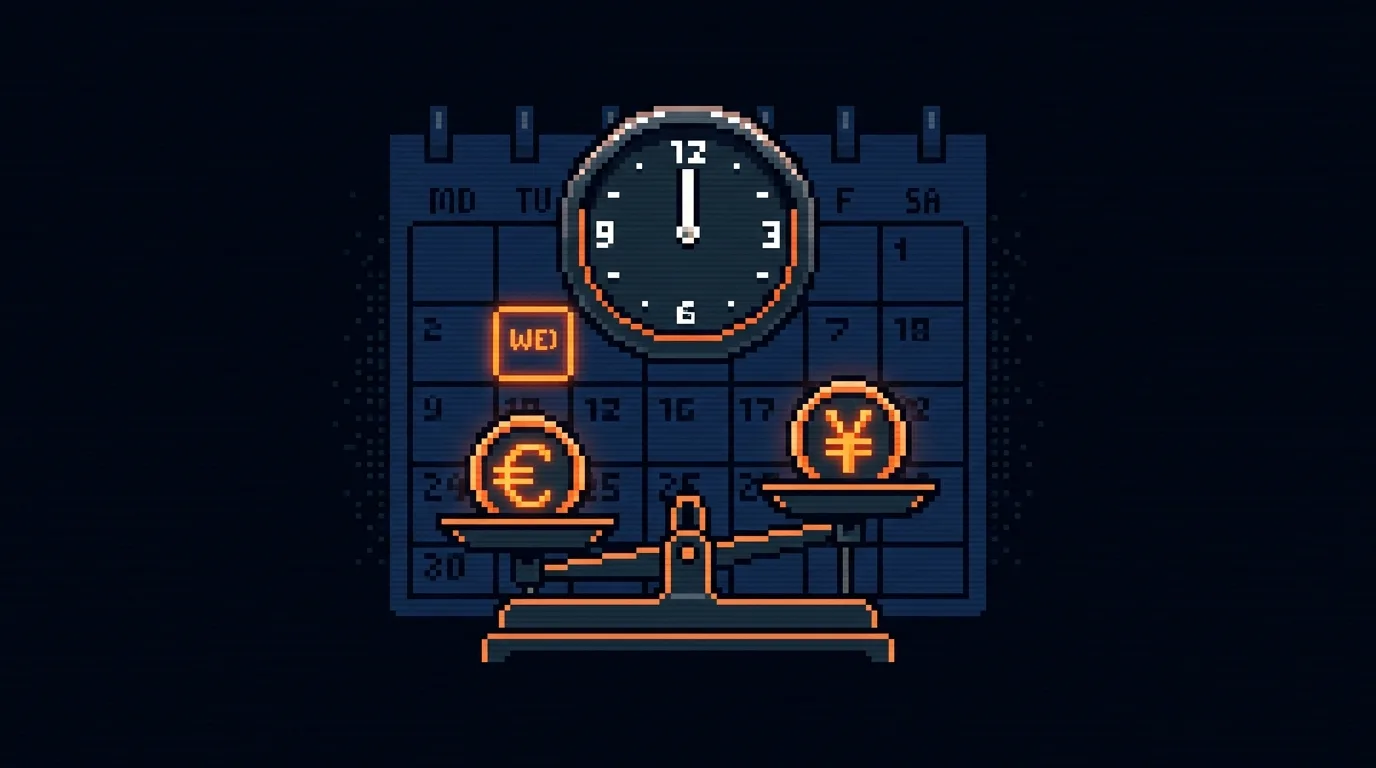
Here is the logic. When you buy EUR/USD, you are effectively borrowing US dollars and holding euros. Each currency has its own overnight interest rate. If the currency you buy carries a higher rate than the one you sell, you may earn a small credit. Reverse that, and you pay.
The specific rate most brokers use as a baseline is called the tom-next rate. That stands for "tomorrow to the next day." It represents the cost in the interbank market of rolling a forex settlement from the next business day to the one after that. Brokers take this rate and layer their own spread or administrative fee on top.
Spot forex typically settles on a T+2 basis, meaning two business days after the trade date. The rollover mechanism pushes that settlement forward by one day each night you hold the trade. The tom-next rate is the price of that push.
IG uses a tom-next-based methodology with an administrative fee (IG Switzerland).
How Does Overnight Financing Work in Forex?
Overnight financing kicks in once per trading day, at a fixed time your broker sets. Understanding how does overnight financing work in forex is essential for anyone holding positions beyond intraday timeframes. If your position is open at that moment, the swap is applied. If it is closed, nothing happens.
What Time Does the Rollover Cutoff Happen?
Every broker sets its own rollover time. A commonly cited rollover point on CFD platforms is 00:00 server time.
IG, as one specific example, applies Wednesday rollovers at 11:00 p.m. Swiss time. The exact time matters more than most traders realize.
Close a position five minutes before rollover, and you avoid that day's swap. Reopen it five minutes after, and a new financing event begins at the next rollover.
Why Is There a Triple Swap on Wednesday?
This is one of the most common questions traders ask. The answer comes down to settlement math, and it is central to understanding overnight financing fees forex explained clearly.
Spot forex settles on a T+2 basis. A position rolled on Wednesday night settles on Friday. But the next settlement date after Friday is Monday, because Saturday and Sunday are not business days. That gap means the Wednesday rollover covers three calendar days of financing: Friday, Saturday, and Sunday.
The result: three days of swap are charged on Wednesday night, while other weeknights carry just one day.
Worth noting: metals and indices may use Friday rather than Wednesday for the triple-swap application at some brokers. Public holidays in either currency's country can also shift multi-day swap charges to a different weeknight.
Always check your broker's instrument specifications and holiday calendar before assuming the Wednesday rule applies uniformly to everything in your portfolio.
Are Swap Fees Charged Daily?
Yes. Are swap fees charged daily in your account? They are applied once per trading day at the broker's rollover time. You will not see separate line items for Saturday or Sunday in your account history, because those days are bundled into the Wednesday (or Friday, for some instruments) triple-swap calculation. You are still paying for them. The charge is just consolidated.
How to Calculate Swap Charges in Forex
Learning how to calculate swap in forex starts with the tom-next rate, adjusted by the broker's own markup, and applied to your position size. The exact formula varies by broker, which is part of what makes comparison tricky.
Many traders use a swap fee calculator forex tool built into their platform to simplify the process.
What Is the General Formula?
Using IG's published methodology as a concrete example for how to calculate swap charges in forex:
- Long positions: number of contracts multiplied by contract value multiplied by the offer swap rate
- Short positions: number of contracts multiplied by contract value multiplied by the bid swap rate
IG states that its forex and spot-metal financing is based on the tom-next rate plus an administrative fee (IG Switzerland figure). Their formula uses 360 as the day-count denominator in the value calculation.
Forex Swap Fees Explained With Examples
Suppose you hold one standard lot (100,000 units) of EUR/USD overnight, and your platform shows a swap rate of -0.5 pips for your direction. Converting pips to decimal for a pair quoted to four decimal places: 0.5 pips = 0.00005. The nightly swap charge would be 100,000 x 0.00005 = $5.00 debit.
On Wednesday, that becomes $5.00 x 3 = $15.00 debit to account for the weekend settlement gap.
| Scenario | Position Size | Swap Rate | Nightly Cost | Wednesday Cost (x3) |
|---|---|---|---|---|
| EUR/USD long (example) | 1 standard lot (100,000 units) | -0.5 pips | $5.00 debit | $15.00 debit |
| EUR/USD short (example) | 1 standard lot (100,000 units) | +0.3 pips | $3.00 credit | $9.00 credit |

The key variable you need from your broker is the actual swap rate for your pair and direction. This is typically displayed in the platform's contract specification or instrument details section. The number on your platform is the number that matters.
Why Does Your Broker's Rate Differ From Others?
| Factor | Why It Varies |
|---|---|
| Tom-next/interbank rate | Changes daily based on market conditions |
| Interest-rate differential | Set by central banks, affects each pair differently |
| Position direction | Long and short attract different rates |
| Notional size | Some brokers tier pricing by volume |
| Broker's financing spread | Each broker adds its own administrative markup |
| Display format | Points, pips, monetary amounts, or symbol-specific values |
Brokers may display swap as points, pips, or a flat monetary figure. The format and underlying methodology differ by broker.
Check the contract specification on your platform rather than relying on third-party swap tables that may be outdated by the time you read them.
Positive Swap Forex Pairs, Negative Swap, and the Carry Trade
Not every swap is a cost. Sometimes it is a credit. Positive swap forex pairs attract traders looking to earn from interest-rate differentials, but the fine print matters, and broker markups can quietly eat what looks like free money.
When Do You Earn a Credit?
A positive swap occurs when the currency you buy has a sufficiently higher applicable overnight rate than the currency you sell, after broker adjustments. In theory, buying a high-yield currency against a low-yield currency should earn you a nightly credit.
In practice, broker markups can shrink or wipe out that credit entirely. It is also worth knowing that both long and short positions can result in a debit, depending on how the broker prices the swap. Do not assume one direction automatically earns.
How Do Forex Swap Rates Relate to the Carry Trade?
The carry trade is a strategy built around earning the interest-rate differential. Understanding forex swap rates carry trade dynamics is essential: you buy the higher-yielding currency and sell the lower-yielding one, aiming to collect positive swap over time.
It sounds clean. The reality is messier. Key risks to keep in mind:
- Exchange-rate movement: A 50-pip adverse move can erase weeks of accumulated swap credits in a single session.
- Spread and slippage costs: Entry and exit spreads eat into the theoretical carry on every round trip.
- Rate-decision reversals: A single central-bank policy change can flip a positive-swap pair to negative swap overnight.
- Tax implications: Swap credits may be taxable income, and swap debits may or may not be deductible, depending on your jurisdiction.
Carry trading requires ongoing monitoring, not a set-and-forget approach. Traders should consult a qualified tax adviser regarding the treatment of overnight financing costs and credits in their jurisdiction.
How to Avoid Swap Fees Forex: Practical Strategies
If you are looking into how to avoid swap fees forex, you have three practical options. None is free of tradeoffs.
Can You Just Close Before Rollover?

Yes. If you close your position before your broker's daily rollover cutoff, no swap is applied for that session. This works well for day traders who never intend to hold overnight. For swing traders, though, repeatedly opening and closing positions introduces spread costs that may rival what you would have paid in swap.
The breakeven point between swap avoidance and spread accumulation depends heavily on the pair and the broker's typical spread width.
What Is Swap Free Forex?
Some brokers offer swap-free accounts, often called Islamic accounts, that do not charge or pay conventional swap. Understanding what is swap free forex is important: these accounts were originally designed to comply with Islamic finance principles that prohibit interest-based charges. Availability and terms vary by jurisdiction and regulatory environment.
However, swap-free does not mean cost-free. These accounts typically compensate through other fee structures: wider spreads, administrative charges, or holding fees that accumulate after a set number of days.
Read the full terms carefully, because the alternative fee can sometimes exceed what conventional swap would have cost.
Does Choosing Specific Pairs Help?
Some currency-pair and direction combinations naturally produce lower swap costs or even positive swap. This varies by broker and changes over time as interest rates shift. Your broker's platform will show you the current rates for each pair in both directions. That is the only source you should trust for live numbers.
| Swap Management Method | Pros | Cons |
|---|---|---|
| Close before rollover | Eliminates swap entirely for that session | Spread costs on re-entry; not practical for swing trading |
| Swap-free (Islamic) account | No conventional swap charge | Often offset by wider spreads or admin fees |
| Select lower-cost pairs/directions | Can reduce or earn positive swap | Rates change over time; broker markups vary |
| Use a swap fee calculator forex tool | Accurate cost estimation before entering a trade | Only as current as the broker's published rates |
How Brokers Set Their Swap Rates: Two Examples
Broker swap methodologies are not standardized. These two documented approaches illustrate the range, and understanding the difference matters when comparing total holding costs across platforms. Knowing how does swap work in forex at each broker helps you make informed decisions.
IG
IG uses a tom-next-based methodology with an administrative fee (IG Switzerland). Long positions use the offer swap rate; short positions use the bid swap rate.
The day-count denominator is 360. The Wednesday triple-swap rule applies at 11:00 p.m. Swiss time. This is clearly documented in IG's Swiss help centre.
Dukascopy
Dukascopy takes a different approach. The broker derives overnight swap rates from central-bank rates, interbank rollover conditions, and carry costs.
It also applies a dynamic rollover policy tied to the relationship between intraday and overnight trading volume over a 30-rolling-day period.
The difference between these two examples shows why comparing swap rates across brokers requires checking each broker's own documentation. Generic tables go stale fast.
Frequently Asked Questions
Was this article helpful?