Pips Lots and Leverage in Forex Trading: What They Mean and How They Work Together

You have opened a demo account. There is a dropdown labeled "lot size," a field for "leverage," and your platform quotes prices to four decimal places. None of it is explained. Understanding pips lots and leverage in forex trading is the first step toward knowing whether a given move makes you $10 or $1,000 on the exact same trade.
Here is the short version. A pip is the smallest standard price movement in a currency pair. A lot is the number of currency units you are trading. Leverage is a ratio that lets you control a larger position with a smaller deposit.
All three connect to determine your profit, your loss, and your actual risk on every position you open. This guide on pips lots and leverage in forex trading breaks down each concept, shows how they interact, and gives you the formulas to calculate position sizes yourself.
What Is a Pip in Forex Trading?
A pip (percentage in point) is the smallest standard price movement in a currency pair. You use it to measure how far a price has moved, how wide a spread is, and how much you have gained or lost on a trade. Grasping pips lots and leverage in forex trading starts with understanding this basic unit.
How Big Is a Pip?
For most currency pairs, one pip equals 0.0001. If EUR/USD moves from 1.1050 to 1.1051, that is one pip.
Japanese yen pairs are the exception. One pip equals 0.01. USD/JPY moving from 150.00 to 150.01 is one pip.
Many retail platforms quote an extra digit beyond the standard pip: five decimal places for most pairs (0.00001) and three for JPY pairs (0.001). This fifth digit is called a pipette or fractional pip and represents one-tenth of a pip. It allows brokers to offer tighter spreads and more precise pricing.
Why care about such a tiny number? Because pips are the building blocks of every forex calculation. Your spread cost, your stop loss, your profit target: all measured in pips. The dollar amount each pip puts into or takes out of your account depends entirely on your lot size.
One limitation worth noting: pip-based thinking can oversimplify risk analysis. A pip on EUR/USD and a pip on an exotic pair like USD/ZAR carry very different dollar values and very different liquidity profiles.
Treating all pips as equal across pairs is a common beginner mistake that the pip framework, by itself, does nothing to prevent.
What Is Lot Size in Forex and Why Does It Matter?
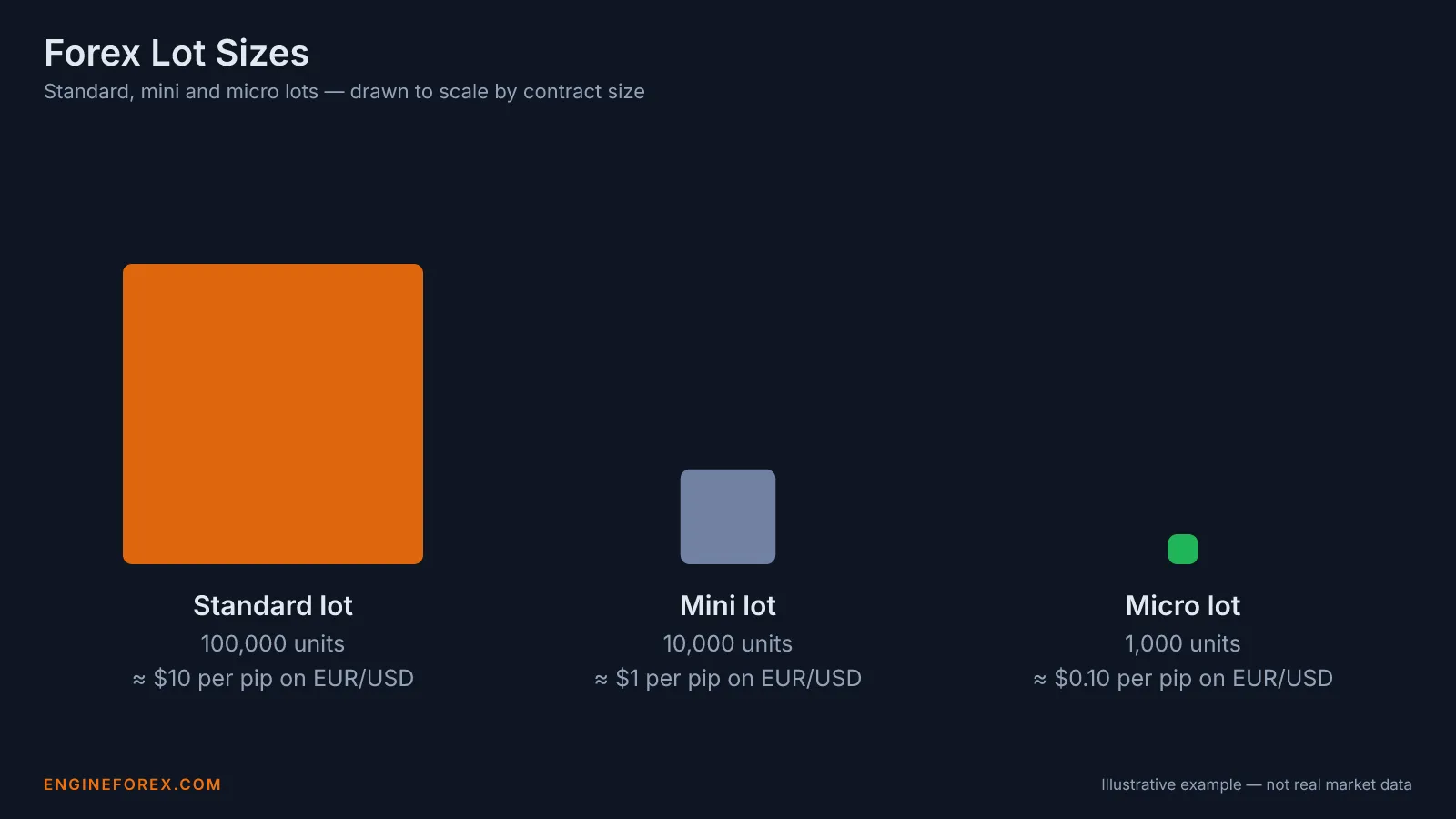
A lot is a standardized unit of trade size. It determines how many units of currency you buy or sell, which directly controls how much money each pip of price movement is worth. Understanding what is lot size and leverage in pips is essential before placing any trade.
How Are Standard, Mini, Micro, and Nano Lots Different?
| Lot Type | Lot Notation | Units of Base Currency | Pip Value (EUR/USD) | Example: 50-Pip Move P&L |
|---|---|---|---|---|
| Standard | 1.00 | 100,000 | $10 per pip | $500 |
| Mini | 0.10 | 10,000 | $1 per pip | $50 |
| Micro | 0.01 | 1,000 | $0.10 per pip | $5 |
| Nano | 0.001 | 100 | $0.01 per pip | $0.50 |
These pip values apply specifically to EUR/USD. For other pairs, pip value differs depending on the quote currency and the current exchange rate.
To calculate pip value when USD is not the quote currency, use: Pip Value = (0.0001 / Quote Currency Exchange Rate) x Lot Size. For a JPY pair example: on USD/JPY at 150.00 trading one standard lot, pip value = (0.01 / 150.00) x 100,000 = approximately $6.67.
How Does Lot Size Affect Pips?
The pip itself never changes size. EUR/USD still moves in increments of 0.0001 whether you are trading one unit or a million. What changes is the cash value attached to each increment.
A 100-pip move on a standard lot equals $1,000. That same 100-pip move on a mini lot equals $100. On a micro lot, $10. The market moved the exact same distance in all three cases.
The only variable was lot size. This is the core of how lot size affects pips in dollar terms.
This is the single most important relationship for newer traders to internalize. Lot size is the dial that controls how much money each pip of movement either adds to or subtracts from your account.
A drawback of the standardized lot system is that it can be inflexible for very small accounts. Not every broker offers nano lots, and even micro lots may represent outsized risk relative to a deposit of a few hundred dollars.
Traders with limited capital may find it difficult to size positions precisely enough to match a disciplined risk percentage.
What Is Leverage in Forex Trading?
Leverage is a ratio that lets you control a larger market position with a smaller amount of your own money. Your broker essentially lends you the difference. The money you put up is called margin, your deposit on the trade. For anyone seeking forex leverage explained for beginners, start here.
What Is 1:100 Leverage in Trading?
At 1:100 leverage, every dollar of your margin controls $100 in market exposure. Put up $1,000 and you control a $100,000 position, one standard lot.
The formula is straightforward:
Margin Required = Position Size / Leverage Ratio
At 1:100, margin for one standard lot (100,000 units) is: 100,000 / 100 = $1,000 in base currency terms. For EUR/USD at approximately 1.10, this converts to roughly $1,100 in USD.
1:100 Leverage vs 1:500: What Actually Changes?
Higher leverage reduces the margin you need to open a position. It does not change your profit or loss per pip. When comparing 1:100 leverage vs 1:500, only the capital locked as margin shifts.
Here is what changes across leverage ratios for one standard lot of EUR/USD:
| Leverage Ratio | Approximate Margin Required (1 Std Lot EUR/USD) | Free Margin on $10,000 Account | Pip Value |
|---|---|---|---|
| 1:30 | $3,667 | $6,333 | $10 |
| 1:100 | $1,100 | $8,900 | $10 |
| 1:200 | $550 | $9,450 | $10 |
| 1:500 | $220 | $9,780 | $10 |
| 1:1000 | $110 | $9,890 | $10 |
These margin figures are approximate, sourced from a single broker educational page. Actual requirements vary by broker and account currency. Notice the pip value column: it remains $10 across every leverage tier because pip value is set by lot size, not leverage.
The critical insight: your cash loss on any trade is driven by lot size, pip value, and stop distance, not by leverage alone. Whether you use 1:100 or 1:500, a one-lot EUR/USD position that hits a 50-pip stop loss costs you $500 either way.
So where is the danger? Higher leverage frees up margin. That extra margin can tempt you to open bigger positions than your account can safely absorb. The leverage itself did not hurt you. The oversized lot you opened with it did.
Most brokers enforce a margin call level (commonly when equity falls to around 100% of used margin) and a stop-out level (often around 50%). When your equity drops to the stop-out threshold, the broker automatically begins closing positions.

The exact percentages vary, so check your broker's margin policy before trading live.
It is also important to recognize that leverage carries genuine structural risks beyond simple overtrading. In fast-moving or illiquid markets, slippage can cause your actual loss to exceed your stop-loss level, meaning you may lose more than the margin you posted.
Negative balance protection policies vary between brokers and jurisdictions, and not all accounts guarantee you cannot owe money beyond your deposit.
Does Leverage Affect Pip Value?
No. Pip value is determined by lot size and the currency pair. Leverage does not appear in the pip value formula at all. This is one of the most common misconceptions surrounding pips lots and leverage in forex trading.
This confusion is understandable. Higher leverage lets you open larger positions with less margin. If you use that freed-up margin to trade a bigger lot, your pip value increases. But the lot size is doing the work, not the leverage ratio.
Think of leverage as a key that opens the door to a bigger room. The room is your lot size. The furniture in that room, your pip value, depends on the room's dimensions, not on the key you used to enter.
Leverage controls your margin requirement. Lot size controls your pip value. Keep those two concepts in separate mental boxes and you avoid a mistake that costs real money.
How to Calculate Lot Size and Leverage: The Formulas You Need
Two formulas matter most. The first tells you how big your position should be. The second tells you how much margin that position will lock up. A pips lots and leverage calculator automates these steps, but knowing the math lets you verify any tool's output.
What Lot Size Should You Trade?
The standard position-sizing formula:
Lot Size = (Account Balance x Risk %) / (Stop Loss in Pips x Pip Value)
Worked example. You have a $10,000 account and you are willing to risk 2% on a EUR/USD trade with a 50-pip stop loss.
- Risk amount: $10,000 x 0.02 = $200
- Pip value per standard lot on EUR/USD: $10
- Lot size: $200 / (50 x $10) = 0.4 lots
You would trade 0.4 standard lots (or 4 mini lots). If your stop is hit, you lose exactly $200, which is 2% of your account. The formula forces discipline. Position sizing through this calculation is the single most underused risk tool available to individual traders.
However, this formula has limitations. It assumes your stop loss will be filled at the exact price you set, which is not guaranteed during high-volatility events such as central bank announcements or weekend gaps.
It also does not account for correlation risk: if you open multiple positions in closely correlated pairs, your actual portfolio risk may be several times larger than the per-trade percentage suggests.
How Much Margin Does Your Position Require?
Margin Required = (Lot Size x Contract Size) / Leverage

Using the 0.4-lot position above with 1:100 leverage:
Margin = (0.4 x 100,000) / 100 = $400
You need $400 of margin, leaving $9,600 of free margin in a $10,000 account. Keep in mind that leveraged positions held overnight also incur swap (rollover) costs, which scale with lot size.
The table below shows how different account sizes, risk percentages, and stop-loss distances produce different lot sizes when applied to EUR/USD:
| Account Balance | Risk % | Stop Loss (Pips) | Risk Amount ($) | Lot Size (EUR/USD) |
|---|---|---|---|---|
| $1,000 | 1% | 30 | $10 | 0.03 (micro) |
| $5,000 | 2% | 50 | $100 | 0.20 (mini) |
| $10,000 | 2% | 50 | $200 | 0.40 (mini) |
| $10,000 | 1% | 100 | $100 | 0.10 (mini) |
| $25,000 | 2% | 50 | $500 | 1.00 (standard) |
How Much Is 0.01 Lot Size Worth Per Pip?
A 0.01 lot equals 1,000 units of the base currency: one micro lot. On EUR/USD, each pip is worth $0.10.
A 100-pip move on this position would mean a $10 gain or loss. This answers the common question of how much is 0.01 lot size worth per pip.
This is the smallest practical lot size most brokers offer. Traders working with smaller accounts will find micro lots valuable because risk levels stay in single dollars rather than hundreds.
How to Use a Pips, Lots and Leverage Calculator
A lot size and leverage calculator automates the formulas above. You enter your account balance, risk percentage, stop-loss distance, and currency pair. The calculator outputs your position size. A quality pips lots and leverage calculator will also display the margin required at your chosen leverage ratio.
When choosing one, look for a calculator that lets you set your account currency (not just USD), select any pair, and input a custom stop-loss distance. Better calculators also show margin required at your chosen leverage.
Now that you understand the underlying math, you can verify any calculator's output yourself. If a calculator gives you a number that does not match the formula, trust the formula. Bear in mind that most free calculators do not factor in spread costs, commissions, or swap rates, all of which reduce net returns and can meaningfully erode profits on smaller positions or longer holding periods.
Regulatory Leverage Limits You Should Know in 2026
Not every broker offers the same maximum leverage. Financial regulators in major jurisdictions cap retail leverage to limit consumer risk exposure.
Based on broker educational resources summarizing CFTC and ESMA rules:
| Jurisdiction | Regulator | Major Pairs Max Leverage | Minor Pairs Max Leverage |
|---|---|---|---|
| US | CFTC | 50:1 | 20:1 |
| EU | ESMA | 30:1 | 20:1 |
| Australia | ASIC | 30:1 | 20:1 |
| Singapore | MAS | 20:1 | 20:1 |
These figures are drawn from broker educational content, not directly from the regulators' own publications. For the most current rules, consult the CFTC, ESMA, ASIC, or MAS websites directly.
Brokers licensed outside these jurisdictions may offer leverage up to 1:500 or 1:1000. Higher available leverage typically signals a lighter regulatory environment, which may mean less investor protection. The leverage you can access depends on where the broker is licensed and which entity holds your account. That distinction matters more than most beginners realize.
A genuine trade-off exists here for retail traders: stricter leverage caps reduce the risk of catastrophic loss, but they also require substantially more capital to take meaningful positions. A trader limited to 30:1 leverage needs over $3,600 in margin just to open a single standard lot on EUR/USD.
For undercapitalized traders, regulatory caps can make standard-lot trading impractical, pushing them toward micro lots or smaller account types with their own constraints on flexibility.
Frequently Asked Questions
Was this article helpful?