What Is CFD Trading and How Does It Work?

So what is CFD trading and how does it work? A CFD, or Contract for Difference, is a derivative contract between you and a broker. You never own the underlying asset. You agree to exchange the difference in price from when you open the position to when you close it.
That single sentence explains the instrument. It does not explain the risk. Across the EU, 74% to 89% of retail CFD accounts lose money. This article lays out the real costs, regulatory data, and contracts for difference explained in plain language so you can judge whether CFDs have any place in your trading plan.
What Does CFD Stand for in Trading?
CFD stands for Contract for Difference. It is a derivative, meaning its value is derived from an underlying asset rather than being the asset itself. When you open a CFD, you enter an over-the-counter (OTC) agreement directly with your broker.
The broker sits on the other side of the trade. No shares land in your name. No currency arrives in your account. No commodity gets shipped anywhere.
CFDs can be written on nearly anything with a quoted price: forex pairs, individual company shares, stock indices, commodities like oil and gold, and cryptocurrencies. That flexibility explains much of their popularity and is central to understanding what is CFD trading and how does it work in practice.
One detail that surprises many beginners: retail forex trading is, in practice, CFD-based. When you trade EUR/USD through a retail broker, you are not buying the currency itself but trading a CFD contract referencing that pair.
Forex is the underlying market. The CFD is the instrument you actually hold. So is CFD forex? Not exactly: forex is the underlying market, while the CFD is the wrapper around it. In my experience reviewing broker platforms, this distinction is rarely made clear during the account-opening process, which is part of the problem.
How Does a CFD Trade Work? A Step-by-Step Breakdown
Understanding what is CFD trading and how does it work starts with the trade lifecycle. You choose an asset, take a position, and settle in cash when you close.
- Choose your instrument and direction. Pick an underlying market and decide whether you expect the price to rise (going long) or fall (going short). The ability to profit from falling prices is one of the defining features of CFDs.
- Define your position size. Select the number of contracts or units. This sets your total exposure, also called the notional value.
- Your broker holds initial margin. You do not pay the full notional value upfront. Instead, the broker sets aside a fraction as margin, a good-faith deposit. If the margin requirement is 10%, a position with a notional value of 10,000 units requires 1,000 units as margin.
- The position moves with the market. Every tick in the underlying price changes your unrealized profit or loss in real time. Your P&L equals the price difference multiplied by your position size. There is no buffer.
- You close the trade. Settlement is always in cash. The price difference between open and close, multiplied by your position size, is credited or debited. Most cash-market CFDs have no fixed expiry date and no delivery obligation. You decide when to exit.
Counterparty risk. Because a CFD is an OTC contract between you and your broker, you carry counterparty risk: if the broker becomes insolvent, your positions and funds may be at risk beyond any investor compensation scheme limits. Regulated brokers must hold client funds in segregated accounts, and schemes such as the UK's FSCS provide limited protection (up to GBP 85,000 per eligible person for investment claims).
These safeguards do not eliminate the risk entirely. This is a meaningful difference from exchange-traded instruments, where a central clearinghouse stands between buyer and seller.
CFD Trading Example
You go long 100 units of Asset X at a price of 50. Your notional exposure is 5,000. With a 10% margin requirement, 500 is held as margin. If the price rises to 55, your profit is (55 minus 50) multiplied by 100, which equals 500. If the price drops to 45, your loss is also 500. The margin did not reduce your risk. It only reduced how much cash you needed to open the position.
| Detail | Value |
|---|---|
| Direction | Long (buy) |
| Units | 100 |
| Entry price | 50 |
| Notional exposure | 5,000 |
| Margin requirement (10%) | 500 |
| Exit price (winning) | 55 |
| Profit at exit | +500 |
| Exit price (losing) | 45 |
| Loss at exit | -500 |
This CFD trading example shows how leverage multiplies both gains and losses in equal measure.
How Does Leverage Affect CFD Trading?
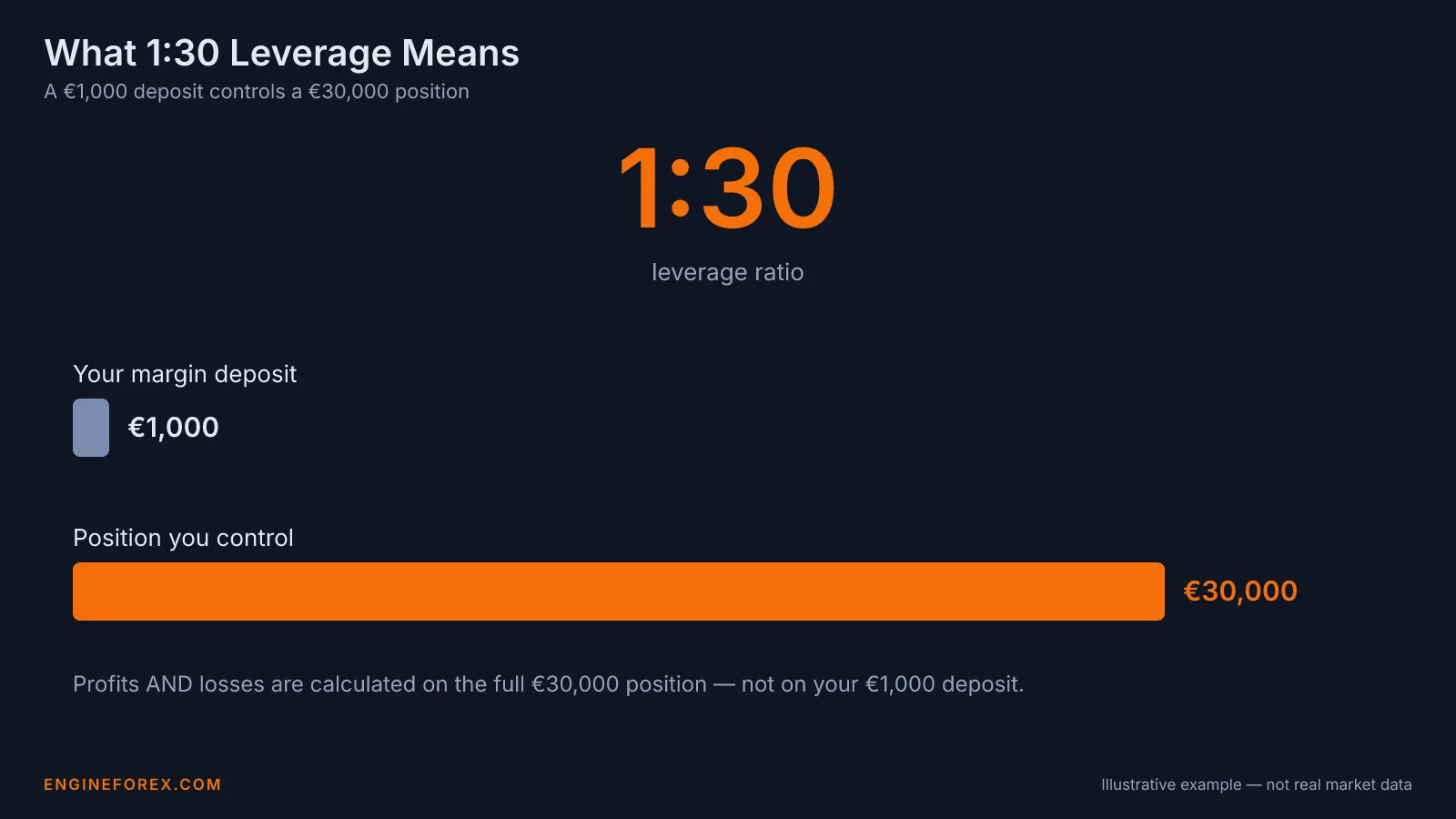
Leverage lets you control a large position with a small deposit. It magnifies gains and losses by the same factor. For anyone asking how does leverage affect CFD trading, the short answer is: it amplifies everything.
What Are the Leverage Caps in the EU and UK?
Under rules introduced by ESMA in 2018 and adopted by the FCA through product intervention measure PS19/18, retail CFD leverage is capped on a tiered scale:
| Asset Class | Maximum Retail Leverage | Margin Required |
|---|---|---|
| Major forex pairs | 30:1 | 3.33% |
| Minor forex pairs, gold, major indices | 20:1 | 5% |
| Other commodities, minor indices | 10:1 | 10% |
| Individual shares | 5:1 | 20% |
| Cryptocurrencies | 2:1 | 50% |
These caps exist for good reason. Before regulation, some brokers offered 200:1 or even 500:1 leverage to retail clients. At 200:1, a 0.5% adverse move wipes out your entire margin.
Negative balance protection (NBP) is also mandatory under FCA and ESMA rules. Your losses cannot exceed the funds in your account. However, NBP is a last-resort backstop, not a substitute for monitoring your margin level.
If the market moves against you and your equity falls below the broker's maintenance margin level, the broker will issue a margin call. If you do not add funds, the broker will automatically close some or all of your positions, often at unfavorable prices during fast-moving markets.
What About Leverage Outside the EU and UK?
ASIC in Australia mirrors the EU tiers for retail clients, capping major forex pairs at 30:1 after its own product intervention in 2021. Many international brokers, however, run entities licensed in jurisdictions such as the Seychelles, Mauritius, or Vanuatu, where leverage of 500:1 or even 1,000:1 is commonly advertised.
Higher leverage is rarely an advantage for retail traders. A 1,000:1 account can be wiped out by a move of 0.1%. Most brokers offering extreme leverage operate under lighter supervisory frameworks that may not require negative balance protection.
If your broker is licensed offshore, check whether NBP is guaranteed in your client agreement, not just implied in marketing.
What Does CFD Trading Cost?
CFD costs come in three layers. The third is the one most beginners overlook. This is essential knowledge for anyone exploring CFD trading for beginners.
| Cost Type | When Charged | Calculated On | Impact |
|---|---|---|---|
| Spread | Every entry and exit | Bid-ask difference | Directly affects breakeven on every trade |
| Commission | Per lot or per trade (some brokers) | Trade size | Most common on share CFDs or raw-spread accounts |
| Slippage | During volatile markets or news events | Difference between expected and filled price | Implicit cost, does not appear on fee schedules |
| Overnight financing (swap) | Every night a position is held | Full notional value of the trade | Can erode or cancel out multi-day gains |
- Spreads. The bid-ask spread is the most visible cost. You pay it every time you enter and exit. For short-term traders, tight spreads matter far more than headline leverage because they directly affect breakeven on every position.
- Commissions. Some brokers charge a separate commission per lot or per trade, particularly on share CFDs or raw-spread accounts.
- Slippage. The difference between the price you expect and the price at which your order fills. Most common during volatile markets or around news events, slippage is an implicit cost that does not appear on any fee schedule.
- Overnight financing (swap). Every night you hold a CFD position, you are charged a financing fee calculated on the full notional value of the trade, not just the margin. Over days and weeks, overnight swap accumulates and can erode or cancel out the result of a longer swing trade. This is the structural disadvantage of using CFDs for anything beyond short-term trading.
Futures contracts, by contrast, embed the cost of carry into their pricing. You pay commission plus exchange fees, but there is no nightly financing charge in the same form.
Is CFD Trading Gambling? What the Regulators Say
The loss statistics are uncomfortable. According to FCA analysis, approximately 82% of UK retail CFD clients lose money. A commonly cited industry figure puts the average loss at around GBP 2,200 per person, though this specific figure does not appear in the FCA's own published documents.
Across the EU, ESMA data shows loss rates between 74% and 89% depending on the broker.
Calling CFDs "gambling" is imprecise. Gambling outcomes are determined by chance. CFD trading involves analyzing markets, managing risk, and making decisions based on price data. A skill component exists.
The problem is that most retail participants either lack that skill, underestimate ongoing costs, or overuse leverage. So is CFD trading gambling? Regulators say no: they classify CFDs as financial instruments, not gambling products.
Regulation includes mandatory risk warnings, leverage caps, and negative balance protection.
Regulatory scrutiny is not easing. In August 2026, the FCA reduced reporting costs for the broader financial industry by GBP 108 million per year but explicitly kept CFDs and spread bets in scope because they are "highly susceptible to market abuse".
That same month, ASIC suspended GFA Capital Markets' license for five months. CySEC reached a EUR 100,000 settlement with RoboMarkets over possible breaches involving CFD marketing and appropriateness assessments during a period from June 2023 to June 28, 2024. South Africa's financial regulator also began investigating CFDs as a growing market abuse trend in August 2026.
As of May 2024, only about 0.7% of UK adults, roughly 380,000 people, held CFDs, spread bets, or rolling spot forex. This is a niche market. And regulators are watching it closely.
Can You Make Money with CFDs?
The data says most people do not. With 74% to 89% of retail accounts in loss, the profitable minority is exactly that: a minority. The same data implies that 11% to 26% of accounts are profitable, at least over measured periods.
But profitability over a single quarter is not the same as earning a sustainable income year after year.
We looked for verified data on the number of people who earn a living solely from CFD trading. No FCA report, ESMA study, or industry survey we located published this figure. Can you live off CFD trading?
The honest answer is that there is no reliable data to support or refute the claim, but the structural headwinds are significant.
Several structural factors work against long-term retail CFD profitability:
- Overnight financing erodes returns on positions held beyond a day.
- You receive no voting rights or shareholder status, since you never own the underlying asset.
- Some index CFDs pay dividend adjustments when constituent shares go ex-dividend, but these reflect the price change rather than conferring actual ownership benefits.
Having reviewed many broker fee schedules, I would note that the overnight financing charge is often the cost traders notice only after it has already eaten into a multi-day position.
CFDs vs. Futures vs. Buying Shares
| Feature | CFDs | Futures | Shares (direct ownership) |
|---|---|---|---|
| Contract structure | OTC, bilateral (you vs. broker) | Exchange-traded, standardized | Direct ownership on exchange |
| Leverage | Yes, capped 30:1 to 2:1 (retail, EU/UK) | Yes, set by exchange margin | No (unless via margin account) |
| Expiry | No fixed expiry (cash CFDs) | Fixed expiry dates | None |
| Overnight financing | Yes, on full notional value nightly | No (cost of carry priced in) | No |
| Ownership rights | None | None (unless held to delivery) | Dividends, voting rights |
| Delivery of asset | No, cash settlement only | Possible (physical delivery) | Yes, you own the shares |
| Typical costs | Spread + swap + possible commission | Commission + exchange fees | Commission + possible custody fee |
The core trade-off: CFDs offer flexibility and low capital requirements but carry ongoing financing costs and no ownership. Futures are standardized and exchange-cleared but demand larger capital and lock you into fixed expiry dates.
Direct share ownership gives you a real economic interest in a company but offers no leverage unless you borrow separately.
Tax treatment varies significantly by jurisdiction. For example, CFDs are generally considered exempt from UK stamp duty, but profits are subject to capital gains tax; treatment differs in Australia, Germany, and other markets. Always consult a qualified tax adviser in your own jurisdiction before trading.
How to Get Started with CFD Trading
If you decide CFDs fit your trading plan, the practical first steps are straightforward. This section is especially relevant for CFD trading for beginners who are navigating the process for the first time.
- Choose a regulated broker. Select a broker regulated by a reputable authority such as the FCA, ASIC, or CySEC.
- Open a demo account. Familiarize yourself with margin mechanics, order types, and how overnight financing accumulates before risking real money.
- Fund a live account with capital you can afford to lose. No amount of preparation eliminates the structural risks outlined above.
- Start with low leverage. Even if your broker allows higher leverage, beginning with smaller positions helps you understand the real impact of price swings on your margin.
- Track every cost. Monitor spreads, commissions, swap charges, and slippage to understand your true breakeven on each trade.
Frequently Asked Questions
Was this article helpful?